


One Person Company Registration in Bangladesh gives a single entrepreneur a corporate structure with one natural-person shareholder, limited liability and a formal legal identity. In Bangladesh, OPCs are governed by the OPC provisions inserted into the Companies Act 1994 through the Companies (Second Amendment) Act 2020. The framework covers formation, nominee arrangements, capital and turnover thresholds, registration, management and compliance.
This guide explains OPC registration in Bangladesh from eligibility and capital requirements to name clearance, incorporation documents, RJSC filing, tax and post-registration compliance. It also highlights an important practical issue for foreign founders: although the statutory definition refers to a natural person, the prescribed incorporation documentation has created a practical NID-related barrier for a foreign individual seeking to incorporate an OPC directly.
Quick Navigation
- What is a One Person Company in Bangladesh?
- OPC Registration Requirements and Eligibility
- Paid-up Capital and Turnover Requirements
- Documents Required for OPC Registration
- OPC Registration Process in Bangladesh
- OPC Registration Cost and Government Fees
- How Long Does OPC Registration Take?
- OPC Annual Compliance After Registration
- TIN, VAT and Tax Compliance
- Can a Foreigner Register an OPC in Bangladesh?
- Converting an OPC to Another Company Structure
- Common OPC Registration Mistakes
- Frequently Asked Questions
What Is a One Person Company in Bangladesh?
A One Person Company (OPC) is a limited company designed around a single natural-person shareholder. The sole shareholder can also serve as the company director, while a nominee is designated to step into the shareholder position if the sole shareholder dies or becomes incapable or unfit to manage the company, subject to the statutory procedure. The OPC provisions also allow managers, a company secretary and other employees to be appointed for management.
The main attraction of an OPC is the combination of single-owner control and a separate corporate identity. Unlike a sole proprietorship, the company is a separate legal entity and the shareholder’s liability is generally limited to the company’s share capital, subject to the applicable law and facts of a particular case.
OPC vs Sole Proprietorship vs Private Limited Company
| Feature | OPC | Sole Proprietorship | Private Limited Company |
|---|---|---|---|
| Shareholders | One natural person | One owner | Two or more shareholders |
| Separate legal entity | Yes | No | Yes |
| Limited liability | Generally yes | No | Generally yes |
| Control | Single shareholder | Single owner | Shared according to ownership/governance |
| Corporate compliance | Required | Lower | Required |
If you are still deciding between OPC and a conventional corporate structure, see our detailed guide to Company Registration in Bangladesh.
OPC Registration Requirements and Eligibility
The statutory OPC framework says a natural person may form an OPC for a lawful purpose and that one natural person may form only one OPC. The prescribed incorporation documents and current RJSC practice should be checked before filing because eligibility and documentation are practical as well as legal questions.
One shareholder
The defining feature is one natural-person shareholder. The shareholder is also the director under the OPC provisions. A manager, company secretary or other employees may be appointed where needed.
One OPC per person
The Companies Act framework provides that a natural person may form only one OPC. This is an important eligibility check before beginning incorporation.
Nominee requirement
The memorandum of an OPC must contain the name and written consent of a nominee. The nominee is intended to become the shareholder if the sole shareholder dies or becomes incapable or unfit to manage the company. The law also provides mechanisms for replacing or changing a nominee.
OPC Paid-up Capital and Turnover Requirements
One of the most important OPC-specific rules concerns the financial thresholds. The Companies (Second Amendment) Act 2020 states that an OPC’s paid-up share capital must be at least BDT 25 lakh and not more than BDT 5 crore. It also specifies that the annual turnover of the immediately preceding financial year must be at least BDT 1 crore and not more than BDT 50 crore.
| OPC financial criterion | Statutory range |
|---|---|
| Minimum paid-up share capital | BDT 25 lakh |
| Maximum paid-up share capital | BDT 5 crore |
| Minimum annual turnover | BDT 1 crore |
| Maximum annual turnover | BDT 50 crore |
If the relevant paid-up capital and turnover exceed the statutory limits, the Act provides a route for conversion into a private limited company or, where applicable, a public limited company, subject to the required conditions.
Documents Required for One Person Company Registration in Bangladesh
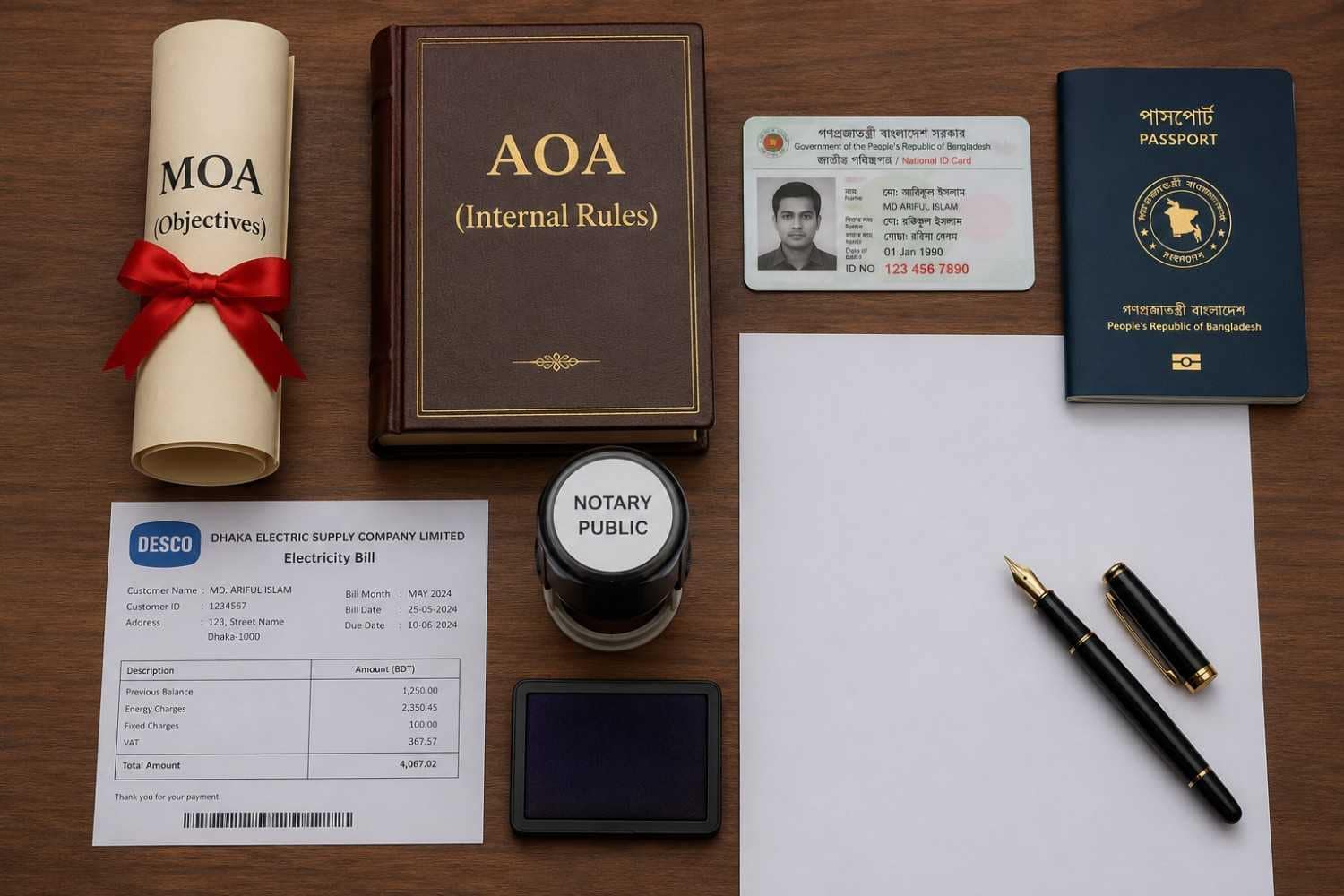
The exact filing set should be checked against the current RJSC forms and portal requirements before submission. A typical OPC incorporation file includes the constitutional documents and identification/nominee information required by the applicable forms.
- Proposed company name and name-clearance information
- Memorandum of Association (MOA)
- Articles of Association (AOA)
- Shareholder/director identification information
- Nominee details and written consent
- Registered-office information and supporting address documents where required
- Prescribed RJSC application and incorporation forms
- Evidence of required capital/payment where applicable
Do not submit a generic document checklist without checking the current RJSC form set. The incorporation forms and schedules are the controlling practical reference for the filing.

OPC Registration Process in Bangladesh
Step 1: Decide the business structure and objects
Confirm that the OPC structure matches the intended business and that the proposed activities are lawful. The company’s objects should be drafted clearly enough to support the actual business model.
Step 2: Choose and clear the company name
Check name availability through the RJSC process and obtain name clearance before moving into incorporation. The final name should follow the statutory naming requirements applicable to an OPC.
Step 3: Prepare the MOA and AOA
The MOA defines the company’s objects and constitutional scope, while the AOA sets out internal governance rules. These documents should be prepared specifically for the proposed business rather than copied from an unrelated company.
Step 4: Prepare shareholder, director and nominee information
Ensure that the identification details, addresses and nominee consent are consistent across the incorporation documents. Small mismatches can trigger queries or correction requests.
Step 5: Submit the incorporation application to RJSC
The OPC registration procedure follows the rules applicable to private limited companies with necessary adaptations. The application and supporting documents are submitted through the applicable RJSC process.
Step 6: Pay applicable government charges
Pay the applicable name-clearance, registration, filing, stamp and related statutory charges. The amount can depend on the company’s capital and the documents/transactions involved, so a fixed fee should not be advertised without checking the current schedule.
Step 7: Respond to RJSC queries
If RJSC raises a query, correct the relevant document or information promptly. Keep the submitted information consistent across the MOA, AOA, forms and supporting records.
Step 8: Receive incorporation documents
Once the application is approved, obtain and securely store the Certificate of Incorporation and other issued/accepted company documents.
OPC Registration Cost in Bangladesh
There is no single universal “OPC registration fee” that applies to every case. The total cost can include government filing charges, name clearance, stamp duty, certified copies or other statutory charges, plus professional fees if an adviser handles the incorporation.
For an accurate quotation, separate government/statutory charges from professional service fees. This is better for users and safer for SEO than publishing an outdated fixed number.
How Long Does OPC Registration Take in Bangladesh?
There is no responsible way to promise a fixed approval time for every application. Processing can depend on name clearance, document accuracy, payment confirmation, RJSC queries and the workload of the relevant authority. A complete and internally consistent file generally reduces avoidable delay.
If a website publishes a service timeline, label it as an estimated processing time and update it when the current RJSC workflow changes.
OPC Annual Compliance After Registration
Registration is the beginning of the company’s compliance lifecycle, not the end. An OPC should maintain the required corporate records and complete its statutory filings and financial reporting obligations on time.
Corporate records
Keep the company’s statutory registers, constitutional documents, resolutions, accounting records and other required corporate records properly organized.
Financial statements and audit
The OPC provisions apply the relevant company-law rules to financial statements and audit with necessary adaptations. The sole shareholder-director should ensure that the company’s accounts and annual reporting are prepared and filed correctly.
Annual returns and RJSC filings
Keep annual returns and other required RJSC filings up to date. The exact filing forms and deadlines should be checked against current RJSC requirements rather than relying on an old blog post.
Director/management meetings
The OPC provisions include a specific meeting requirement for the sole person, including at least one director’s meeting in each half of a calendar year. Maintain the required records and minutes in accordance with the applicable law and current practice.
TIN, VAT and Tax Compliance for an OPC
After incorporation, the company may have separate tax and VAT obligations depending on its activities, turnover and applicable law. Registration of the company with RJSC does not by itself complete every tax or VAT requirement.
TIN and corporate income tax
Obtain and maintain the appropriate tax registration and file corporate income-tax returns and related statements within the applicable deadlines.
VAT and BIN
Whether VAT registration/enlistment is required depends on the business activity and applicable turnover rules. Check the current NBR requirements before assuming that every OPC needs the same VAT treatment.
Withholding and other tax obligations
An OPC may also have withholding-tax and other reporting obligations depending on payments, employees, suppliers and transactions. Keep records from the beginning rather than waiting until the return-filing deadline.
Can a Foreigner Register an OPC in Bangladesh?
This is an area where the website should be especially careful. The statutory definition and formation provision refer to a natural person, and the Act does not simply state a blanket foreign-national prohibition. However, legal commentary and practical guides have identified a documentation problem: the prescribed OPC incorporation schedule asks for an NID number, while a foreign national normally does not have a Bangladeshi NID.
Therefore, do not publish an unconditional statement that “foreigners can register an OPC directly” or “foreigners are legally prohibited” without checking the current RJSC practice and applicable investment rules. For a foreign founder, a Bangladesh private limited company may be a more established route for direct foreign shareholding, while OPC eligibility should be confirmed case-by-case with current RJSC requirements.
Foreign investors who need a more established corporate structure may also consider Foreign Company Registration in Bangladesh.
Can an OPC Be Converted Into Another Company Structure?
Yes. The OPC framework contains a conversion mechanism where the statutory financial thresholds are exceeded, subject to the applicable conditions and procedure. A growing business may also consider conversion when it needs additional shareholders, investment or a different governance structure.
If ownership changes after incorporation, the applicable Share Transfer in Bangladesh procedure should also be followed.
Common OPC Registration Mistakes to Avoid
- Using a company name without checking RJSC availability.
- Copying MOA/AOA clauses that do not match the actual business.
- Submitting inconsistent NID, address or nominee information.
- Ignoring the OPC-specific capital and turnover thresholds.
- Publishing outdated government fees or guaranteed approval times.
- Assuming incorporation automatically completes TIN, VAT and tax compliance.
- Failing to maintain corporate records after incorporation.
- Using an old article that contains contradictory statements about foreign founders.
Key Benefits of OPC Registration in Bangladesh
- Single-owner control: one natural-person shareholder can own and control the company within the legal framework.
- Separate corporate identity: the company operates as a separate legal entity.
- Limited liability: the corporate structure can provide liability protection subject to applicable law.
- Corporate credibility: an incorporated company can provide a more formal structure for contracts, banking and business relationships.
- Continuity planning: the nominee mechanism addresses succession if the sole shareholder dies or becomes incapable.
- Growth path: the law provides for conversion when the business no longer fits the OPC thresholds or structure.


Frequently Asked Questions About OPC Registration in Bangladesh
What is OPC registration in Bangladesh?
OPC registration in Bangladesh is the legal incorporation of a one-person company under the OPC provisions of the Companies Act 1994, as amended. It is a corporate structure built around one natural-person shareholder.
What is the minimum paid-up capital for an OPC in Bangladesh?
The statutory minimum paid-up share capital is BDT 25 lakh, with the statutory maximum set at BDT 5 crore.
What is the turnover range for an OPC?
The statutory turnover range for the immediately preceding financial year is BDT 1 crore to BDT 50 crore.
Can one person own more than one OPC?
The OPC provisions state that a natural person may form only one OPC.
Is a nominee required for an OPC?
Yes. The memorandum must include the nominee’s name and written consent under the OPC framework.
Can a foreign national directly register an OPC?
The statutory language and the prescribed incorporation documentation need to be considered together. The practical NID requirement has been identified as a barrier for foreign individuals, so foreign founders should verify current RJSC practice before choosing the OPC route.
How much does OPC registration cost?
The total cost depends on statutory charges, capital-related fees, stamp duty, filing requirements and any professional service fee. Check the current RJSC schedule before publishing a fixed price.
How long does OPC registration take?
Processing time varies with name clearance, document quality, payment verification, queries and RJSC workload. Avoid promising a guaranteed number of days.
What happens after OPC incorporation?
After incorporation, the company must continue with corporate records, financial reporting, annual returns and applicable tax/VAT obligations. Incorporation is the start of the compliance lifecycle.
Need Help With OPC Registration in Bangladesh?
If you are planning One Person Company Registration in Bangladesh, the safest approach is to confirm the current RJSC forms, capital/turnover eligibility, nominee documentation and post-incorporation compliance before filing. A professional registration service can help prepare the incorporation documents, coordinate filing and keep the company on track with its ongoing obligations.









Leave a Reply