

Understanding how to change ownership is crucial in the corporate world. This process is vital for both private and public companies looking to move equity, bring in new capital, or change leadership. Knowing the legal framework is key for any business owner. By learning the rules set by the RJSC (Registrar of Joint Stock Companies and Firms), you keep your business compliant and flexible.


For newcomers to the local market, starting with proper company registration in Bangladesh is essential. Keeping accurate records is vital during any ownership change. We’ll guide you through every step needed to keep your business running smoothly.
Key Takeaways
Ownership changes are essential for corporate restructuring and growth. Compliance with RJSC regulations is mandatory for all legal entities. Proper documentation prevents future disputes between stakeholders.
New investors can be brought in to strengthen business operations. Mastering this transfer process ensures long-term continuity for your firm.
Understanding the Legal Framework for Company Share Transfer in Bangladesh
Managing a business in Bangladesh requires a deep understanding of the legal framework that governs ownership changes. Adhering to these regulations ensures your corporate records are accurate and legally binding. Following the Companies Act, 1994 is crucial for maintaining a healthy business structure.
Regulatory Authority of the Registrar of Joint Stock Companies and Firms
The Registrar of Joint Stock Companies and Firms, or RJSC, oversees all corporate entities. This authority manages the official records of every company in Bangladesh. When you initiate this type of transfer, ensure all filings meet the RJSC’s standards.
The RJSC demands detailed documentation for every change in ownership. By following their guidelines, you safeguard your company from legal disputes. Proper documentation is essential for a smooth process with the registrar.
Distinction Between Private and Public Limited Company Transfers
The legal requirements vary based on the company type. Private companies face stricter internal restrictions, as outlined in their Articles of Association. Public companies, however, must comply with broader securities regulations to protect their shareholders.
| Feature | Private Limited | Public Limited |
| Transfer Restriction | High (Internal Approval) | Low (Market Driven) |
| Regulatory Oversight | RJSC Focused | SEC and RJSC |
| Documentation | Board Resolution Required | Public Disclosure Required |
It’s crucial to understand these differences for any stakeholder involved in this kind of ownership change . Private entities focus on internal control, while public entities prioritize market transparency. Consulting your Articles of Association will help clarify the specific rules for your company.
The Right of Pre-emption and Priority Rights of Existing Shareholders
Protecting your company’s internal structure begins with the right of pre-emption. This legal mechanism ensures that when a member exits, the remaining partners control who joins. Understanding this right is crucial to ensure smooth transitions during any ownership change.
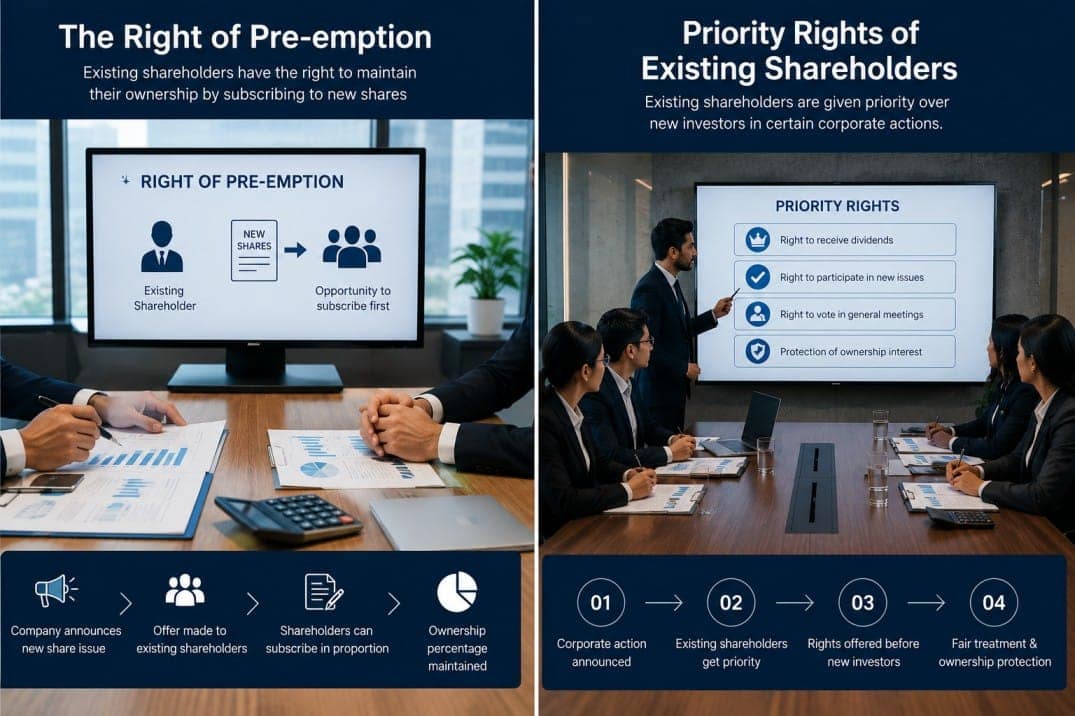

Why Existing Shareholders Get First Refusal
The right of first refusal acts as a protective barrier for your business. It grants current members the exclusive opportunity to purchase shares before they are offered to outside parties. This priority right prevents unwanted external interference and keeps the company’s vision aligned with its original founders.
By exercising this right, you ensure that the ownership remains within a trusted circle. It is a standard practice that safeguards the interests of those who have already invested time and capital into the firm. This process is essential for maintaining the integrity of a properly registered company.
Strengthening Business Stability Through Internal Transfers
Prioritizing internal transfers fosters long-term commitment among your stakeholders. When shares are kept within the existing group, the company avoids the risks associated with bringing in unknown third parties. This strategic approach to share management is a cornerstone of effective corporate governance.
The following table outlines the primary benefits of utilizing pre-emption rights during ownership changes.
| Benefit | Impact on Business | Governance Outcome |
| Ownership Control | Prevents hostile takeovers | High stability |
| Trusted Partners | Maintains core values | Unified vision |
| Reduced Conflict | Minimizes external disputes | Smooth operations |
By focusing on internal stability, you create a resilient environment for growth. This method of share management ensures that your business remains focused on its goals without the distraction of sudden ownership shifts. Ultimately, these rights are designed to protect the longevity and success of your enterprise.
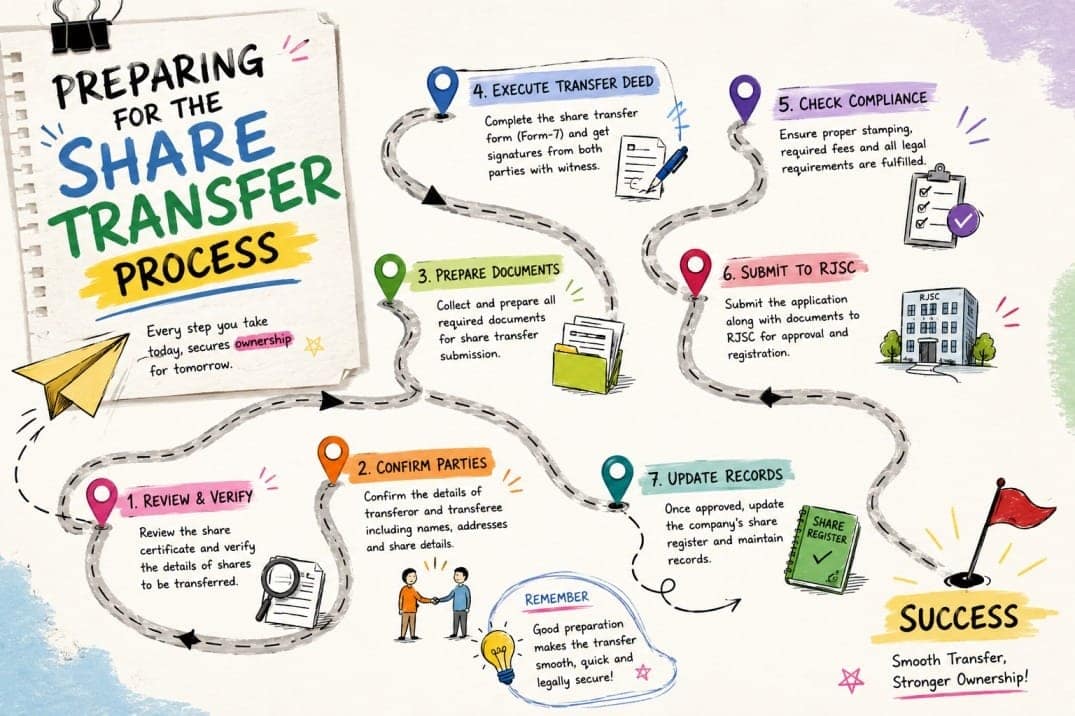
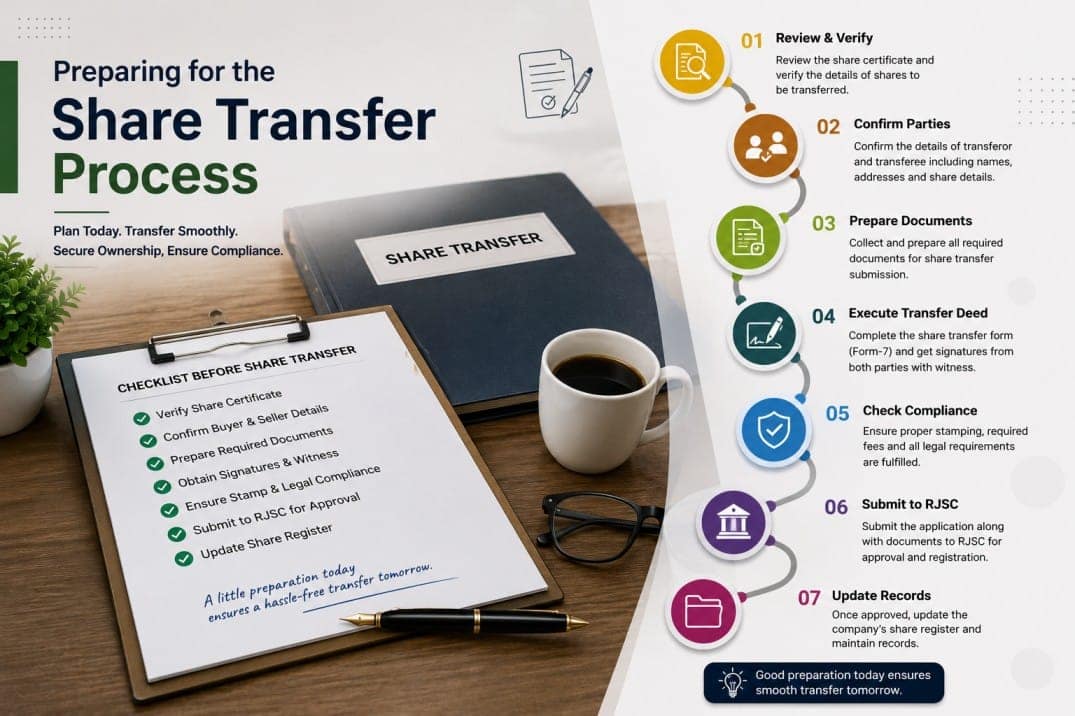
Preparing for a Company Share Transfer in Bangladesh
Understanding the intricacies of this process demands a well-thought-out preparation strategy. It’s crucial to align your internal records with the latest legal standards before starting any transaction. This proactive step can prevent common administrative hurdles that often slow down the approval process.
Reviewing the Articles of Association
Firstly, thoroughly review your company’s Articles of Association. This foundational document outlines your business’s structure and often includes rules on share transfers. You need to pinpoint any pre-emptive rights or board approval mandates that govern the transfer process.
Ignoring these internal regulations can invalidate a transfer or lead to legal complications. Always check if the articles mandate a specific notice period for current shareholders before offering shares to outsiders. This ensures the transfer adheres to both internal policies and national laws.
Valuation of Shares for Private Limited Companies
Accurate share valuation is crucial for fairness between the transferor and transferee. In private limited companies, shares are not publicly traded, making fair market value determination a director’s key responsibility. Documenting the valuation method ensures transparency for all stakeholders.
Proper valuation helps avoid future disputes and maintains the company’s overall financial integrity. Detailed internal documentation simplifies the verification process. When preparing for your next share transfer, consider these factors:
| Preparation Step | Primary Objective | Key Benefit |
| Article Review | Identify restrictions | Legal compliance |
| Share Valuation | Determine fair price | Stakeholder fairness |
| Board Approval | Formalize intent | Administrative clarity |
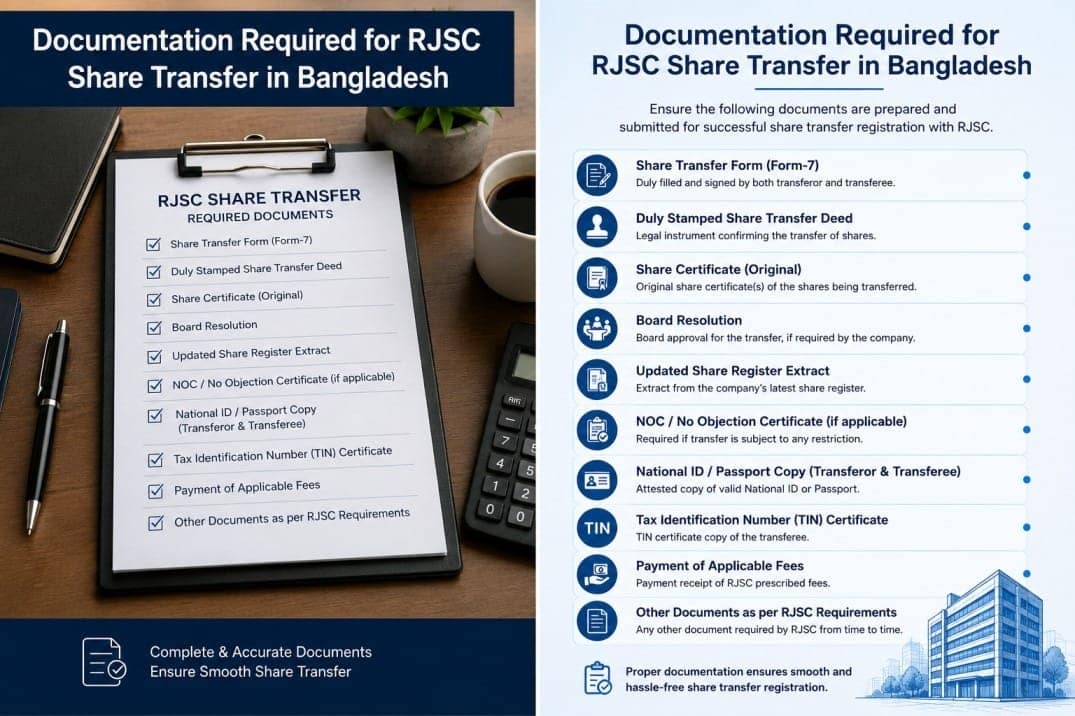
Documentation Required for RJSC Share Transfer in Bangladesh
Initiating this process hinges on the quality of your documentation. The regulatory bodies demand precise paperwork to ensure that all ownership changes adhere to the Companies Act. By meticulously preparing your files, you avoid the risk of rejection and ensure a smooth transition for your organization.
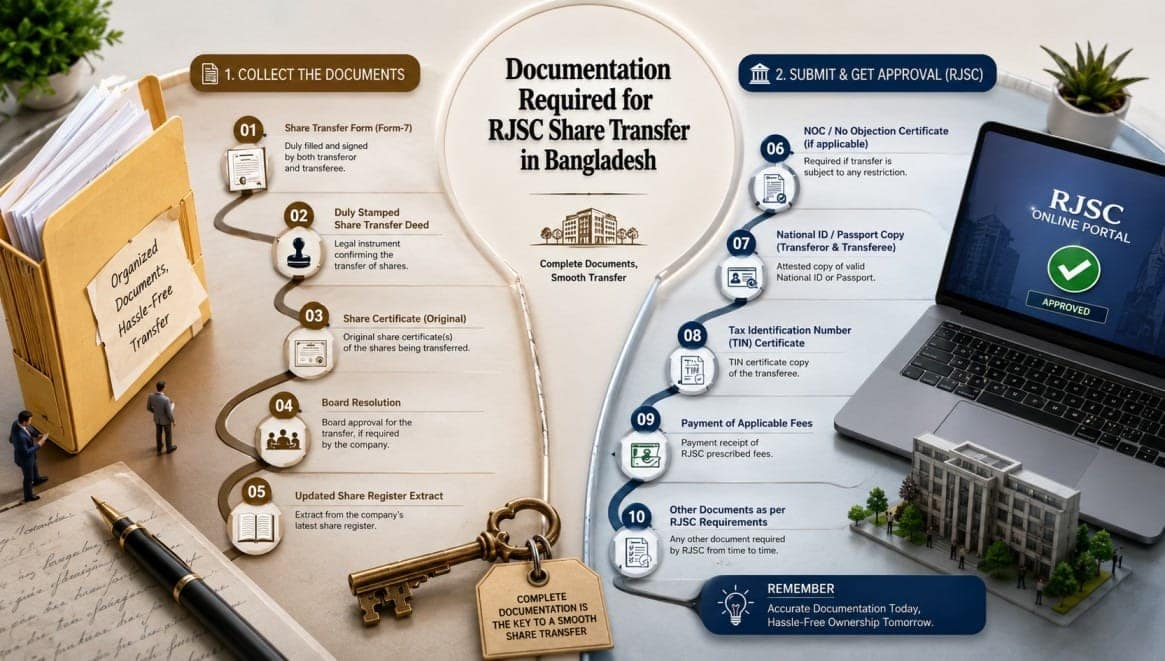
Drafting the Instrument of Transfer
The instrument of transfer is the primary legal contract between the transferor and the transferee. It must clearly state the names of both parties, the number of shares being transferred, and the consideration amount. Accuracy in this document is vital to prevent administrative delays during the filing process.
After drafting, the instrument must be properly stamped according to the current stamp duty regulations. Failure to affix the correct stamp duty can invalidate the entire transfer.
Joint stock Company Share Transfer in Bangladesh. Ensure the document is signed by both parties and witnessed by a credible individual to maintain its legal integrity.
Board Resolution Requirements for Share Transfers
A formal board resolution is a mandatory prerequisite for any share transfer. This document acts as the official authorization from the company’s leadership, confirming that the board has reviewed and approved the proposed change in shareholding. Your resolution should explicitly mention the date of the meeting and the specific approval of the transfer.
The language used in the resolution must be clear and unambiguous to satisfy regulatory scrutiny. It should state that the board has verified the eligibility of the transferee and that the company’s Articles of Association permit the transfer. Maintaining a certified copy of this resolution in your corporate records is essential for future audits and compliance checks.
| Document Name | Purpose | Key Requirement |
| Instrument of Transfer | Legal ownership change | Proper stamp duty |
| Board Resolution | Corporate authorization | Certified copy |
| Share Certificate | Proof of ownership | Surrender of old certificate |
By adhering to these documentation standards, you streamline the entire process significantly. Proper preparation shields your company from unnecessary legal hurdles and ensures that your corporate records remain accurate and up to date.
Step-by-Step Procedure for Executing a Share Transfer
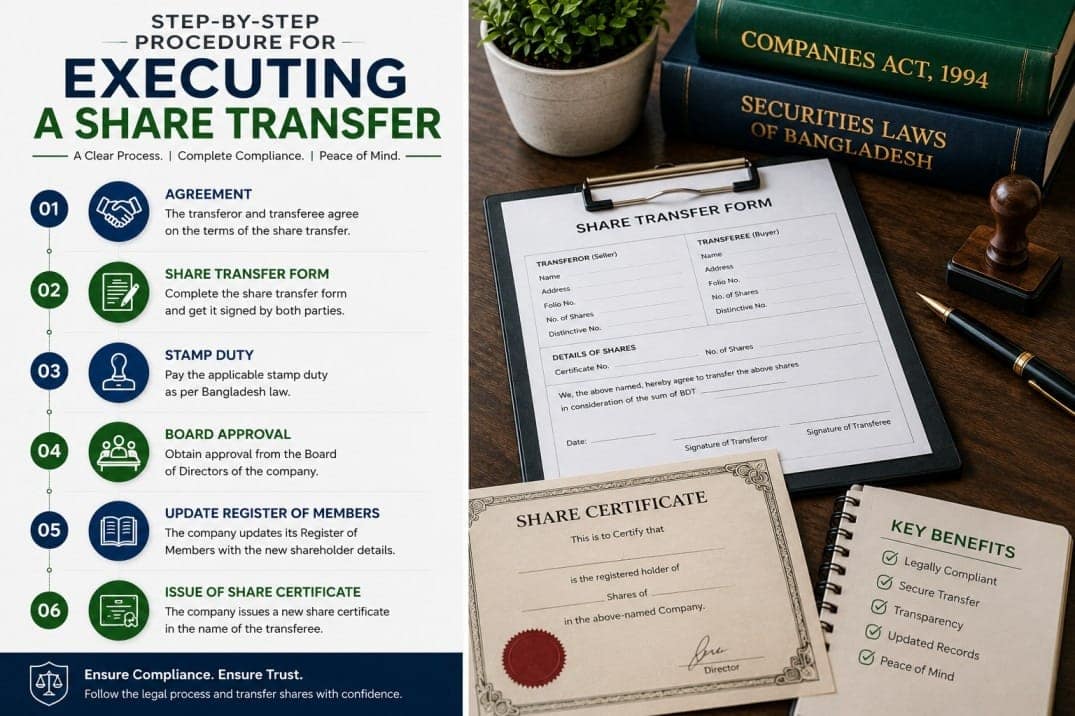
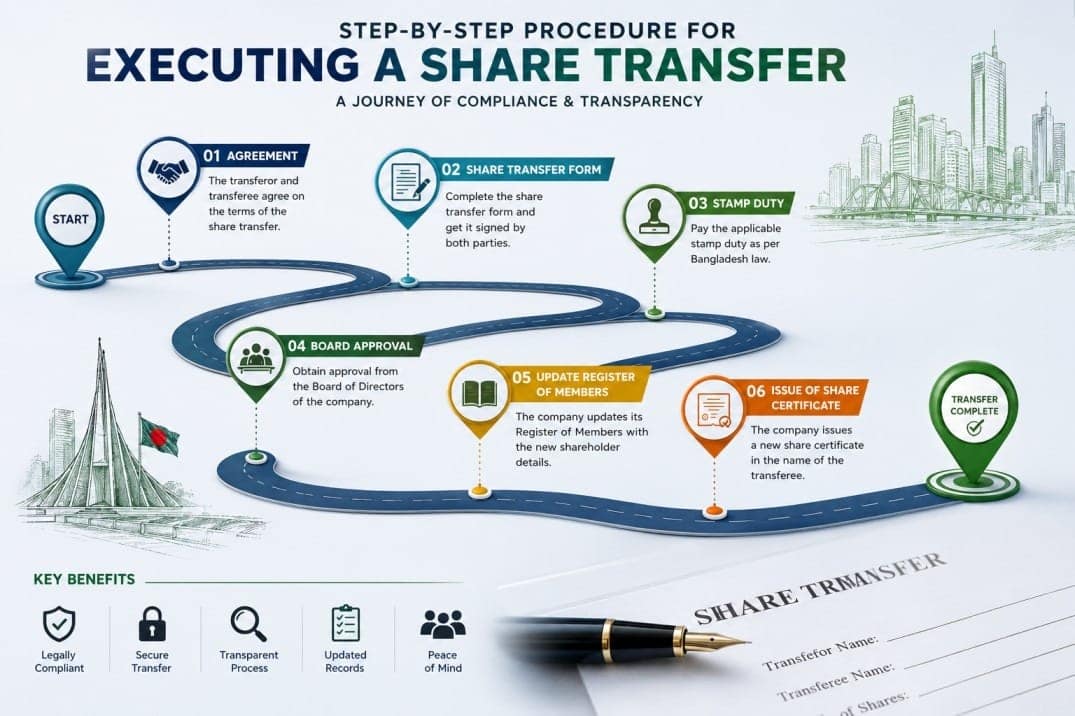
To successfully execute a share transfer, follow a clear, methodical approach. Proper documentation ensures that every share transfer remains legally binding and transparent. This protects the interests of all stakeholders involved in the transaction.
Executing the Share Transfer Form
The process starts with the formal execution of the instrument of transfer, known as the share transfer form. This document must be signed by both the transferor and the transferee to be valid. When managing this process, ensure the document is stamped according to current government regulations.
Once signed, the form acts as primary evidence of the change in ownership. Verify that all details, including the number of shares and the consideration amount, are accurately recorded. This step is crucial for maintaining the integrity of your corporate records.
Updating the Register of Members
After the transfer form is executed, you must update the company’s register of members. This internal record is definitive proof of share ownership for your company. Failure to update this register can lead to significant administrative complications and potential legal disputes.
Ensure the date of the transfer and the details of the new shareholder are entered promptly. Keeping this register current is a mandatory legal obligation that safeguards the rights of all parties. The following table outlines the key components you must track during this process.
| Action Item | Responsible Party | Required Document |
| Execution of Transfer | Transferor & Transferee | Instrument of Transfer |
| Board Approval | Board of Directors | Board Resolution |
| Register Update | Company Secretary | Register of Members |
| Final Filing | Authorized Signatory | Share transfer at rjsc |
By maintaining these records, your company remains compliant with local laws. Consistent documentation makes any future transfer smoother and less prone to delays. Always prioritize accuracy when handling these sensitive corporate filings.
Integrating New Directors and Shareholders via Form XII
Introducing new stakeholders to your company’s structure requires specific documentation with the RJSC. When your board appoints a new director or welcomes a new shareholder through a share transfer, these changes must be formalized. This process is crucial for managing a share transfer effectively.
When to File Form XII with the RJSC
It’s vital to submit your documentation on time to keep your company in good standing. You must file Form XII whenever there’s a change in the board of directors or the shareholding pattern. Not doing so within the set timeframe can result in penalties and administrative issues.
Typically, you should file this form within 14 days after the board’s resolution. Keeping your records up to date ensures the entire process stays transparent and legally compliant. Always double-check that the form details align with your internal member register.
Legal Implications of Adding New Stakeholders
Introducing new directors or shareholders has significant legal implications for your organization. New directors take on fiduciary duties and are legally accountable for the company’s compliance with laws. New shareholders gain rights like voting power and the right to dividends, which must be documented.
By filing the necessary paperwork with the RJSC,(Office of the Registrar of Joint Stock Companies And Firms) you safeguard your company from future disputes over ownership or management authority. Proper documentation is the primary proof of your corporate structure. Use the following table to understand the key requirements for these filings.
| Document Type | Purpose | Filing Deadline |
| Form XII | Director/Shareholder Change | 14 Days |
| Board Resolution | Approval of Appointment | Immediate |
| Transfer Instrument | Share Ownership Change | 30 Days |
Capital Expansion Through Share Allotment
Expanding your business in Bangladesh requires strategic decisions on equity structure. Boosting marketing strength or operational capacity necessitates capital increase. Understanding equity management ensures compliance and financial goals achievement. As businesses grow, additional capital is often needed to support expansion, strengthen operations. Joint Stock Share Allotment in Bangladesh provides an effective way to raise funds by issuing new shares to existing shareholders or new investors. This approach allows companies to secure capital without increasing debt obligations.
In Bangladesh, a share capital increase must be carried out in compliance with applicable corporate regulations and approved through the necessary corporate resolutions and filings. A properly planned Company Share Allotment in Bangladesh helps improve financial stability, attract investment, and support long-term business growth while maintaining regulatory compliance.
Distinguishing Between Share Transfer and Share Allotment
A company share transfer involves moving shares from one person to another. This doesn’t alter the company’s total paid-up capital. It merely changes ownership among current or new shareholders.
Company Share Allotment in Bangladesh is issuing new shares, increasing the total shares. This action brings in fresh capital, crucial for expansion or new market entries.
Increasing Authorized and Paid-up Capital
Raising this limit allows for new share allotment, increasing paid-up capital.
This move provides liquidity for scaling your business. Planning your capital structure makes your company attractive to investors while maintaining equity control. The table below outlines the differences between these actions.
| Feature | Share Transfer | Share Allotment |
| Capital Impact | No change to total capital | Increases paid-up capital |
| Primary Purpose | Change of ownership | Raising new funds |
| Regulatory Focus | Updating member register | Issuing new certificates |
| Involved Parties | Buyer and Seller | Company and Subscriber |
Taxation and Stamp Duty Considerations
Understanding the fiscal landscape of a joint stock company in Bangladesh is crucial. You must account for various financial liabilities when initiating a transfer. This ensures your business remains compliant with local regulations. Ignoring these costs can lead to unexpected penalties and legal issues.
While many focus on the administrative steps, the financial aspect is equally important. Whether it’s a simple share transfer or a complex share allotment, accurate record-keeping is key for stability.
Calculating Stamp Duty on Share Transfers
Stamp duty is a mandatory tax on the transfer instrument. In Bangladesh, it’s calculated on an ad valorem basis, as a percentage of the shares’ value. The valuation must reflect the current market price or face value, depending on regulatory requirements.
To calculate duty correctly, refer to the latest government schedule. Paying the correct stamp duty is essential for the RJSC to process your application. Any payment shortfall will likely result in document rejection, causing delays.
Tax Obligations for Transferors and Transferees
Both the buyer and seller have tax responsibilities during this process. The transferor is liable for capital gains tax on the profit from the sale. It’s your duty to report this income accurately in your annual tax return to avoid scrutiny from the National Board of Revenue.
The transferee must also be aware of their obligations, especially regarding the source of funds for the purchase. Maintaining transparent financial records protects both parties from future audits. The following table summarizes the key financial components you should track during this process:
| Financial Item | Responsible Party | Purpose |
| Stamp Duty | Transferee | Legal validation of transfer |
| Capital Gains Tax | Transferor | Tax on profit from sale |
| Processing Fees | Company/Applicant | RJSC administrative costs |
By staying informed about these tax obligations, your Joint Stock Company in Bangladesh operates legally. Professional guidance is often recommended to navigate these calculations accurately and maintain corporate compliance.
Common Challenges in Company Share Transfer in Bangladesh
Even with careful planning, you may encounter hurdles during this process. Corporate administration often involves complex interpersonal and regulatory dynamics that can slow down your progress. Anticipating these issues allows you to implement effective mitigation strategies to protect your company’s interests.
Handling Disputes Among Shareholders
Internal disagreements often arise when existing shareholders feel their rights are being overlooked or when valuation methods are contested. These conflicts can stall the entire process if not addressed through clear communication and adherence to the Articles of Association. Mediation is a powerful tool to resolve these disputes before they escalate into legal battles.


Ensure that all shareholders are fully informed about the transfer terms well in advance. Transparency helps build trust and reduces the likelihood of opposition. If a deadlock occurs, referring to the specific clauses in your company’s governing documents provides a neutral framework for reaching a resolution.
Overcoming Administrative Delays at the RJSC
Navigating this process requires patience and meticulous attention to detail. Administrative delays often stem from incomplete documentation or minor errors in the filing process. To ensure smooth processing, verify that every form is signed correctly and that all supporting documents are attached.
Proactive follow-ups with the regulatory office can help you track the status of your application. Utilizing the official digital portal effectively minimizes the risk of manual processing errors. Maintaining a well-organized file of your correspondence and submission receipts is essential for resolving any queries raised by the authorities quickly.
| Challenge Type | Primary Cause | Mitigation Strategy |
| Shareholder Conflict | Lack of transparency | Early mediation |
| Documentation Error | Incomplete filings | Double-check compliance |
| Company share transfer rjsc delay | System backlog | Regular status tracking |
Special Considerations for Foreign Company Share Transfer
Foreign capital in your business complicates ownership changes. You face unique rules beyond local norms. It’s crucial to follow both national and international laws for your license. When a foreign or joint venture company share transfer is involved, additional regulatory compliance and documentation may be required. Businesses must follow applicable foreign investment and foreign exchange regulations in Bangladesh to ensure a smooth and legally compliant transfer of ownership.
Compliance with Bangladesh Investment Development Authority
First, you must work with the Bangladesh Investment Development Authority (BIDA). They manage foreign direct investment and check equity changes. You need their approval for ownership changes.
Without approval, you face penalties or account freezes. A share transfer at RJSC for foreign entities relies on BIDA’s approval. Keep your investment registration current to reflect share changes.
Repatriation of Funds and Regulatory Reporting
Exiting a foreign investor requires strict Bangladesh Bank rules. Ensure share valuation meets international standards for capital outflow. Proper documentation is key for legal fund repatriation through authorized banks.
For joint venture transfers, detailed central bank reports are mandatory. These confirm the transaction’s compliance with foreign exchange laws. Transparency in reporting avoids legal issues later.
| Requirement Type | Local Company | Foreign/JV Company |
| Primary Regulator | RJSC Only | RJSC, BIDA, & Bangladesh Bank |
| Valuation Basis | Face Value/Market Value | Fair Market Value (Audit Required) |
| Fund Movement | Local Banking | Authorized Dealer Bank (Repatriation) |
| Reporting Scope | Internal Records | Cross-border Compliance |
Adhering to these steps safeguards your investment and ensures smooth transitions. Consult legal experts in cross-border law to avoid risks. Proactive regulatory filings keep your business compliant in Bangladesh.
Ensuring Compliance and Long-term Corporate Governance
Maintaining accurate records is crucial for a healthy business environment in Bangladesh. Your dedication to transparency safeguards your stakeholders and secures your company’s future.
Effective management of this process avoids legal issues later on. Regular audits of your internal registers are essential to reflect current ownership structures accurately. This ensures your operations meet the standards required for proper company registration.
Strategic planning is key when handling a joint venture transfer. It’s important to ensure all filings accurately reflect your board’s intentions. Regular updates to your corporate documentation build trust with investors and regulatory bodies.
Effective oversight of your filings lays a solid foundation for growth. Keeping your statutory books updated and accessible brings peace of mind. Consult with your legal counsel to review your governance practices and protect your company’s long-term success.
FAQ
What is the legal framework for a company share transfer in Bangladesh?
The Companies Act, 1994 is the primary law. The process is regulated by the Registrar of Joint Stock Companies and Firms (RJSC) and must follow the company’s Articles of Association.
What is the process for a company share transfer in Bangladesh?
The key steps are:
Review Articles of Association
Execute Form 117 (share transfer deed)
Pay stamp duty
Obtain board approval
File documents with RJSC
Update Register of Members and issue new certificate
What documents are required for a company share transfer in Bangladesh?
You need:
Executed Form 117
Original share certificates
Board resolution
Consent letters from both parties
Stamped transfer form
Extract from Register of Members
How is stamp duty calculated for a company share transfer in Bangladesh?
Stamp duty is based on the market value or consideration amount of the shares, whichever is higher. Payment must be made on the transfer form as per government rates.
Can the board refuse a company share transfer in Bangladesh?
Yes, if:
The Articles of Association allow refusal, or
The transfer violates applicable rules.
The refusal must be recorded in a board meeting with valid reasons.
How long does a company share transfer in Bangladesh take?
It typically takes 4 to 8 weeks, depending on document completeness and RJSC processing time.
What is the process for a foreign company share transfer in Bangladesh?
Foreign transfers require:
Compliance with the Foreign Exchange Regulation Act
Bangladesh Bank approval
Fair valuation evidence
Inward remittance through a local bank
How do you handle a joint venture company share transfer in Bangladesh?
Coordination between local and foreign partners is essential. Ensure:
Valuation matches the shareholder agreement
RJSC and Bangladesh Bank compliance
Official records are updated after approval
What happens after RJSC approves a company share transfer in Bangladesh?
After approval:
Update the Register of Members
Cancel the old share certificate
Issue a new certificate to the transferee
Maintain proper records for compliance
-
RJSC Company Registration in Bangladesh
RJSC Company Registration in Bangladesh is handled exclusively by the Registrar of Joint Stock Companies and Firms (RJSC), the sole government authority for this process. Larger businesses typically register as limited companies, where two or more entrepreneurs come together, pool significant investment, and combine the diverse expertise of multiple directors. Several factors have positioned Bangladesh…
-
Company Registration in Bangladesh: Complete 2026 Guide
Embarking on a new business journey demands a strong legal base for enduring success. If you’re setting up your business, you must carefully navigate the Company Registration in Bangladesh process. This step is crucial for your venture’s long-term viability. Every entrepreneur must grasp the regulatory framework set by the Company Act 1994. This law lays…
-
Partnership Firm Registration in Bangladesh
Partnership Firm Registration in Bangladesh requires a solid legal foundation to ensure your enterprise thrives. In the local market, understanding the regulatory framework is essential for long-term success. Navigating the requirements for Partnership Firm Registration at RJSC in Bangladesh helps you protect your interests and build credibility with stakeholders. Formalizing your business entity provides a…
-
Foreign Company Registration in Bangladesh
Foreign Company Registration in Bangladesh allows overseas investors to establish a legal business presence in Bangladesh through different structures, including a locally incorporated foreign-owned company, joint venture, branch office, or liaison/representative office. Bangladesh permits 100% foreign ownership in many sectors, although certain restricted or controlled industries may have additional conditions, approvals, or ownership limitations. Therefore,…
-
Company share allotment in Bangladesh
Company Share Allotment in Bangladesh is a vital corporate procedure for any growing enterprise. When you decide to increase your paid-up capital, you engage in a standard administrative procedure to issue new ownership stakes. This routine practice helps your organization attract fresh investment and strengthen its financial foundation. Navigating the legal landscape requires strict adherence…
-
Joint Venture Company Registration in Bangladesh
Starting a business in Bangladesh with a local or foreign partner can be an effective way to combine capital, technology, market knowledge, and business expertise. Joint Venture Company Registration in Bangladesh provides a structured way for two or more parties to establish a business relationship and operate through an incorporated company. A joint venture may…
-
Schedule X Submission in Bangladesh | RJSC Annual Return Filing in Bangladesh Guide
Running a business demands strict to local laws to keep your legal status intact. For entities registered with the Registrar of Joint Stock Companies and Firms (RJSC), submitting your Schedule X Submission in Bangladesh / RJSC Annual Return Filing in Bangladesh a crucial annual task. Compliance shields your firm from fines and legal hurdles. Our…
-
Company Winding Up in Bangladesh (2026)
Closing a business is more than just stopping operations. Company winding up in Bangladesh involves legally dissolving your organization and clearing all outstanding obligations. Winding Up Company in Bangladesh demands strict adherence to local laws to safeguard your interests. Many entrepreneurs wonder, can a private limited company be closed in Bangladesh? The answer is affirmative,…
-
One Person Company (OPC) Registration in Bangladesh
One Person Company Registration in Bangladesh gives a single entrepreneur a corporate structure with one natural-person shareholder, limited liability and a formal legal identity. In Bangladesh, OPCs are governed by the OPC provisions inserted into the Companies Act 1994 through the Companies (Second Amendment) Act 2020. The framework covers formation, nominee arrangements, capital and turnover…
-
Branch Office Registration in Bangladesh: Complete Guide 2026
The South Asian market is ripe with opportunities for global companies looking to expand. By setting up a local branch, your firm can oversee operations and forge deep connections with local partners. Understanding the legal framework is crucial. This Branch Office Guide Bangladesh offers the clarity needed to meet all local legal standards. Adhering to…
-
Liaison Office Registration in Bangladesh : Complete Guide
Foreign companies that want to explore the Bangladesh market without immediately establishing a full commercial operation may consider setting up a liaison office or representative office, subject to the applicable regulatory approvals. Liaison Office Registration in Bangladesh generally involves obtaining the necessary approval from the Bangladesh Investment Development Authority (BIDA), completing the required formalities with…
-
Society Registration in Bangladesh – Complete RJSC Guide
Setting up a non-profit organization is crucial for those focused on charity, education, or culture. It’s essential to grasp the legal framework to ensure your group operates transparently and legally. To comply, you must adhere to certain protocols. Mastering the steps for society registration in Bangladesh streamlines your path to recognition. This guide offers a…
-
Foundation Registration in Bangladesh: Complete RJSC Foundation Formation Guide
Setting up a non-profit entity demands a solid legal foundation for lasting credibility. Registering your Foundation Registration in Bangladesh is crucial for any charitable or educational project. It’s the cornerstone of your initiative. This step grants your organization the legal standing to operate openly. By adhering to the foundation registration at RJSC in Bangladesh guidelines,…
-
Trade Organization Registration in Bangladesh: Complete RJSC Guide
Setting up a formal industry body involves specific legal steps to achieve official status. If you’re planning to start a professional association, understanding the Trade Organization Registration in Bangladesh is crucial. It’s your first step towards success. This process ensures your entity gains the necessary advocacy power to represent your members effectively. By following the…











Leave a Reply